
Home › Eye surgery › Intraocular lens types
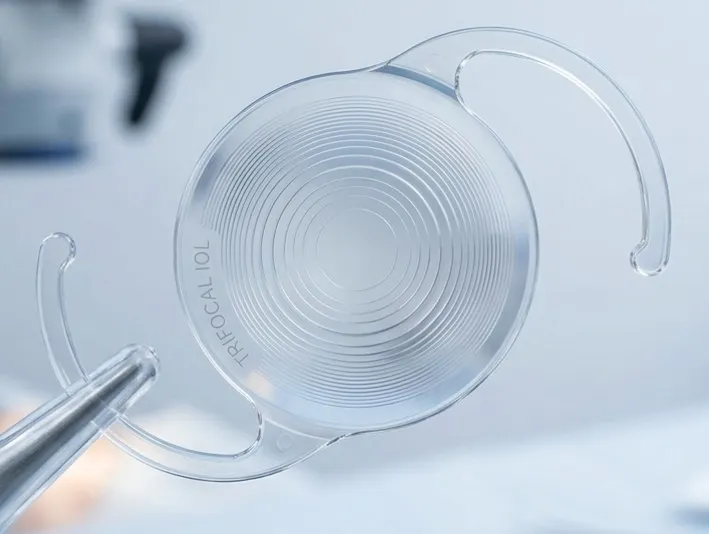
During cataract surgery or lens exchange, your natural lens is replaced with an artificial intraocular lens (IOL). It is made of a biocompatible material that the eye accepts very well, and it stays in the eye for the rest of your life.
The choice of lens is individual and depends on your needs, hobbies and the condition of your eye. Assoc. Prof. MUDr. Ivajlo Popov will help you choose from these categories:
The choice of lens will affect your vision for decades to come. At the initial examination, Assoc. Prof. Popov will discuss your lifestyle in detail so that together you find the solution that gives you the best possible visual comfort.
The monofocal lens is the most commonly used implant in cataract surgery. It has one focal point, so it provides sharp, clear vision at one distance – usually for distance.
You agree on the so-called target distance with the surgeon in advance. Most patients choose sharp distance vision (driving, television). In that case you will need reading glasses for reading, your phone or sewing, and possibly weaker glasses for intermediate distance when working at a computer.
For patients who do not mind wearing reading glasses, for those with another eye condition (advanced glaucoma, retinal disease) and for people doing visually demanding work in low light. If you want to be independent of glasses, ask about EDOF or multifocal lenses.
They are designed for patients with astigmatism. They can correct an irregular curvature of the cornea, which standard lenses cannot. They are available in monofocal, EDOF and multifocal versions.
EDOF (Extended Depth of Focus) lenses are among the best premium lenses. Instead of a single point, they create one continuous, extended range of focus, so vision moves smoothly from distance to intermediate without “jumps” in the image.
The main disadvantage is the higher price. Some clinics offer cheaper “EDOF” lenses that are often not true EDOF lenses but only modified monofocal ones. Assoc. Prof. MUDr. Ivajlo Popov will help you choose correctly.
The original multifocal lenses were practically bifocal; later came trifocal lenses with three focal points. Today’s modern multifocal lenses mostly have a continuous range of focus – they mimic the ability of a healthy lens to refocus smoothly from distance to reading.
Who they are ideal for: active people who work with digital devices, do sport, drive and want to read without constantly looking for their glasses.
For younger patients with high prescriptions, the natural lens is not replaced; instead, a lens is placed in front of it. More on the page Phakic ICL lenses.
The clinic has no contracts with health insurance companies, so the same price list applies to self-paying and insured patients.
Patients with Slovak health insurance can apply to their insurer for a contribution towards treatment by a non-contracted provider: VŠZP, Dôvera, Union.
The choice is individual – it depends on your needs, hobbies and the condition of your eye. You will go through it with the doctor at the initial examination.
With a monofocal lens, usually yes – for reading and often also for intermediate distance. With an EDOF lens you can manage most everyday activities without glasses, and with a multifocal lens most patients stop wearing glasses altogether.
No. An artificial lens does not age or become cloudy again. Later on, the lens capsule may become cloudy (secondary cataract), which is treated with a short laser procedure.
Assoc. Prof. MUDr. Ivajlo Popov, PhD. personally performs the examination and the surgery.
Consultations and examinations: Ambulancia Oftalentis, Saratovská 24, 841 02 Bratislava – Dúbravka
Office hours: Monday 16:00–18:00, by appointment only; other times by arrangement via e-mail
Surgery: the place of surgery is agreed during the examination