
Home › Eye surgery › Cataract surgery
From the first examination to the surgery itself, you are cared for by the same doctor – Assoc. Prof. MUDr. Ivajlo Popov, PhD., an eye surgeon with experience from the Department of Ophthalmology of Comenius University and University Hospital Bratislava.
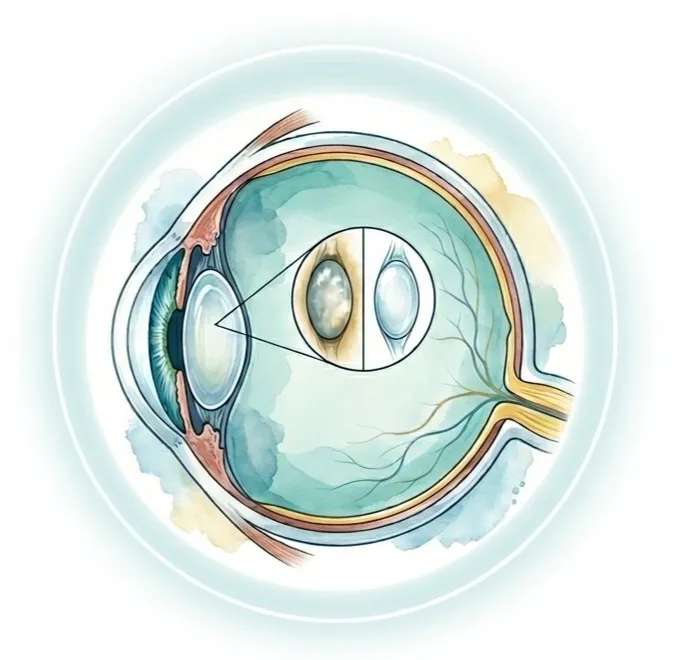
A cataract is the gradual clouding of the eye’s natural lens. It is most often related to age, but it can be accelerated by diabetes, long-term use of corticosteroids, an eye injury or previous eye surgery. A cataract is painless and develops slowly and inconspicuously.
The only effective treatment for cataract is surgery, in which the clouded lens is replaced with an artificial intraocular lens. Eye drops or glasses cannot remove a cataract.
There is no need to wait until the cataract is “ripe”. What matters is how much it limits you in everyday life:
An advanced cataract is more demanding for the surgeon and the operation may take longer, so there is no benefit in postponing it unnecessarily. You will decide on the right time together with the doctor at the initial examination.
The lens can also be replaced without a cataract if you want to stop wearing glasses after the age of 45 (PRELEX). This procedure is not covered by health insurance.
“Laser cataract surgery” is a common marketing term. In so-called femto-cataract surgery, a femtosecond laser performs only some of the steps, mainly the incisions. The rest of the operation, including removal of the lens by ultrasound, is the same as in conventional surgery.
The type of artificial lens determines how you will see for decades to come – whether you will need reading glasses or can do without glasses. All prices include a navigation system and an aspheric lens with a blue filter.
A comparison of the advantages and disadvantages of each lens can be found on the page Lens types.
The clinic has no contracts with health insurance companies, so the same price list applies to self-paying and insured patients.
Patients with Slovak health insurance can apply to their insurer for a contribution towards treatment by a non-contracted provider: VŠZP, Dôvera, Union.
Examination with consultation 100 €, pre-operative examination 70 €. If you have surgery with us, the price of the consultation is deducted from the final price.
No. The eye is numbed with drops, sometimes with additional local anaesthesia. During the procedure you may feel touch or pressure, but no pain. After surgery there may be mild stinging or a foreign-body sensation, which subsides within a few days.
The procedure itself usually takes 10–15 minutes. You go home the same day, accompanied by someone.
Most patients notice a significant improvement the very next day. Vision settles within a few weeks, after which new glasses can be prescribed if needed.
The doctor will decide when you can drive again at the post-operative check-up, depending on how well you see. Do not drive on the day of surgery.
Both eyes can be operated on at the same time or one after the other. You will decide together with the doctor, based on his recommendation and your preference.
The clinic has no contracts with health insurance companies, so the same price list applies to self-paying and insured patients. Patients with Slovak health insurance can apply to their insurer for a contribution towards treatment by a non-contracted provider.
The artificial lens does not become cloudy. In some patients, the lens capsule becomes cloudy months or years later (secondary cataract). This is treated with a short, painless laser procedure in the clinic.
Assoc. Prof. MUDr. Ivajlo Popov, PhD. personally performs the examination and the surgery.
Consultations and examinations: Ambulancia Oftalentis, Saratovská 24, 841 02 Bratislava – Dúbravka
Office hours: Monday 16:00–18:00, by appointment only; other times by arrangement via e-mail
Surgery: the place of surgery is agreed during the examination